
A Father’s Day Reflection: The Gift of a Steady Anchor—What a 'Stepdad' Taught Me About True Fatherhood

Updated: Jun 21
Guest Contributor Disclaimer: The views and opinions expressed in this article are those of the author and do not necessarily reflect the views of Enough Adoption Foundation. This content is provided for informational purposes only and is not intended as medical, mental health, legal, or professional advice.
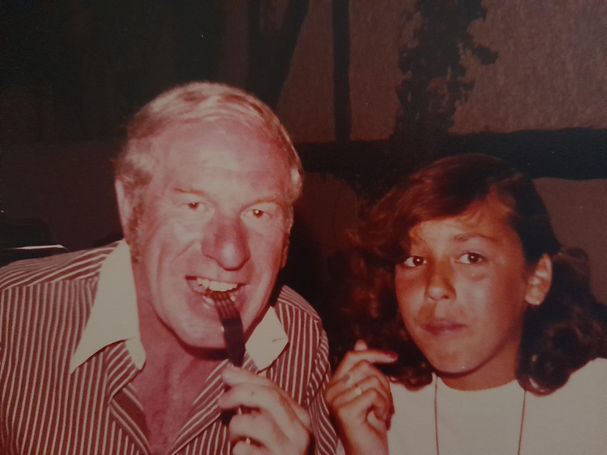
Father’s Day often arrives with a flood of traditional images—biological lineages, shared family trees, and childhood photos where a father and child look identical. We are conditioned to believe that the deepest bonds are forged in DNA, or secured by legal documents, and that the title of "Father" is something automatically inherited rather than actively earned.
But real fatherhood isn't about how a man becomes a parent. It is about how he chooses to operate as one. It is built in the daily, conscious decision to stay, to love, and to be a safe harbor.
The person who fell in love with my mom and gained me almost as an add-on was the one who ended up being there the most.
Two months ago, on the 6th of April, I lost that man. His name was Brian.
When the Enough Adoption Foundation intentionally asked me to write a reflection for Father’s Day following his passing, I felt deeply honored. They asked me because of this raw loss, and it feels like the right moment to talk about what it truly means to be a father, and how our perspective on that love changes as we move through life, and being adopted gives a different lens.
Brian wasn't my birth dad, and I never actually called him "Dad." Yet, he was the absolute definition of one. Before his funeral service, I wrote a tribute. I wanted everyone in that room to know exactly how I felt about the man who shaped my world.
My Tribute to Brian
Brian was my dad.
I never called him dad, and I didn’t have his name, but he was my dad.
He was warm, steady, and safe. His love was unconditional.
I remember the first Christmas card he gave me a really beautiful card, with the words and music to Silent Night on the front, and a simple Christmas greeting from him inside. I still have it today.
When I was older, we would sometimes go out together, play a game of pool, have a pint on a Saturday lunchtime while Mom was at work. We had our time together, just him and me. A quiet, fun, real connection that felt good for both of us.
He was gentle. Easy-going. Always joking, always making people laugh. I think that’s how we’ll all remember him.
He lived with integrity, and he had a strong sense of loyalty.
You could see how he felt in his eyes, if he was happy, proud, or touched by something.
I know he loved us all so very much. And he adored both Matthew and Ryan. It was clear in the way he looked at them.
He wasn’t a man of words, but he didn’t need them. His presence was something you could feel, and his hugs made you feel like everything was going to be okay.
He had a way of silently holding you.
Looking back, I think that’s why that Christmas card has meant so much. A reminder that words aren't needed.
I feel lucky to have had him in my life. A true gentleman. And as I’ve moved through life, especially in harder moments, I’ve often thought of him, how he never seemed to worry. I’ve tried to carry that with me, and only now, being older, I realize how much that matters.
He was a gift. As are his lovely family. And he will always remain wrapped in my heart.
The Lessons of Chosen Love
What Brian gave me is the ultimate proof of what adoption, foster, and blended family foundations stand for every single day: unconditional love requires no biological prerequisite.
I realize now that there was never a moment I thought he would not be there, which for an adoptee means a lot. He gave me hugs that made the rest of the world fade away.
At his funeral, the song I chose was one he loved: "Don't Worry, Be Happy." It was the ultimate reflection of how he lived. Brian taught me to just be okay with everything. It sounds simple, but as adults, we rarely allow ourselves to actually do it, do we? We overthink, we carry anxiety around like it’s our best friend, and we let the world pull us apart, and if the world doesn't, we do a good job of it ourselves. Brian didn't. He carried a steady, unworried calm. I know my mom at times thought he was too unworried.
By no means was he a perfect father. He was generationally influenced, disliked fixing or fitting things, and he had his imperfections just like anyone else. But he taught me that fatherhood is a daily practice of showing up without question or condition.
Looking at the "Missing Data"
In the world of support and therapy, we often sit with people who are navigating complex family dynamics, identity questions, and ideas of belonging. So often, what people are searching for is exactly what I found in Brian: a profound sense of safety. They want a parent whose love is an anchor, not a transaction.
Men today are under an immense amount of pressure. Roles have changed dramatically over the years for both men and women, but in the midst of that evolution, the traditional role of a man and a father should not be lost. True masculinity is integrity, loyalty, and offering safety without control. Yet, many fathers wonder if they are getting it right, and they can feel paralyzed by the fear of showing emotions, always thinking they need to be the tough guy. Strength does not mean control.
When a father is wondering “How do I handle this?” it may be because something from his own childhood was missing. As children, we look to learn from our parents. If you are a father struggling to connect, and at times feel lost, it is worth looking back at your own past to see how you wanted to be met as a child. What was missing for you?
Ask yourself a very honest question: Were you afraid to tell your father [parents] something? If the answer is yes that is incredibly useful data.
If you grew up carrying that fear, you know exactly what armor feels like, what unheard feels like. In practice, there was a man who stands out who was completely unaware that he had experienced childhood trauma. But during discussions, it soon became apparent that growing up, he was never allowed to cry. The moment it was explained to him that being denied the right to shed tears and express pain is, in itself, traumatic. With that realization decades of repressed emotion broke free, and tears flowed.
The Balance of Vulnerability and Boundaries
That story highlights the delicate balance of modern fatherhood. To change the way men have traditionally been expected to hide their feelings, we have to allow ourselves to be human. But we also have to recognize a vital rule of parenting overall: children should not feel responsible for adults' tears.
I know this from my own experience. In the past, my kids felt that my tears were because of them, when in reality, they were simply because I didn't know what to do in a moment of overwhelm. It can feel uncomfortable, and children automatically think, "This is my fault," or "I need to fix this," and they find themselves stepping into the adult role.
That completely flips the healthy order of caregiving. If you do cry in front of your children, the traditional role of the protector means you must offer immediate reassurance. You must be able to say, "I am sad right now, but I am the adult. I am okay, and it is not your job to fix this."
Parenting is hard, and sometimes we might not act in a way that we are proud of. But being able to look at yourself, own up to your mistakes, and apologize to your child when you get it wrong teaches them that honesty and healthy connections go a long way. That is how you remain an anchor, even when you are vulnerable.
Age, Loss, and Perspective
Losing someone impacts you entirely differently depending on where you are in the stages of your own life. I am 57 now. If I had lost a father figure at 37, it probably would have hit me in a completely different way. It might have felt unfinished, disruptive, or full of angry, unanswered questions.
But Brian was 90. He had just celebrated his 90th birthday. He lived a good, long, and full life. His passing was expected, and because of that, the grief I feel right now has ease with it. It’s a missing of him not sitting in his chair or doing the dishes. I don’t sit here wishing he was here for any longer; he didn't need to be. He did his job, and he did it well.
That is one of the most important things that happens when you experience the loss of someone from this vantage point in life: you suddenly find that other things just aren’t so important anymore. The daily dramas, the unmanicured lawn - they just fall away. I look at the legacy of a man who loved unconditionally and chose not to worry, and I realize that is such an important part of what is left. That is what I carry forward.
The Men Who Choose to Anchor
To every bio dad, foster dad, adoptive dad, stepdad, and male mentor reading this who is currently showing up for a child: please know that your presence is everything.
You do not need perfection, nor do you need documentation to hold a child in love and provide safety. Children need a true gentleman who is easy-going, full of integrity, and fiercely loyal. They need to look across a room during a difficult moment and see a father figure who offers a gentle, silent reminder that everything is going to be okay, someone they can go to and say, “I've messed up," without fear of judgement.
When we strip away the commercialism of Father’s Day, we are left with the core of what the day is actually meant to honor: the anchors of our lives. In my case a man of few words, but infinite presence.
This year, the space Brian left behind is immense. But as I miss his hugs, his smile, and his eyebrow wiggle, I am filled with an overwhelming sense of gratitude.
Thank you, Brian. And Happy Father's Day to you, and to all the dads who are making better choices every day, whether they know it or not.

About the Author
Sarah Patstone is a transracial adult adoptee of mixed White and Indian heritage. Originally from the United Kingdom and now living in Portugal, she is the creator of The Foundational Selves, a personalized coaching framework that helps individuals develop emotional stability and explore their sense of identity. Her work is informed by both her lived experience as an adoptee and her experience supporting others on similar journeys, actively partnering with those she works with as they navigate deep personal change. To find out more about her work and practice, visit sarahpatstone.com.

Did this article resonate with you? Make a donation, share our mission, and follow Enough Adoption Foundation on Instagram, Facebook, and LinkedIn to stay engaged as we build this future together.

Comments